
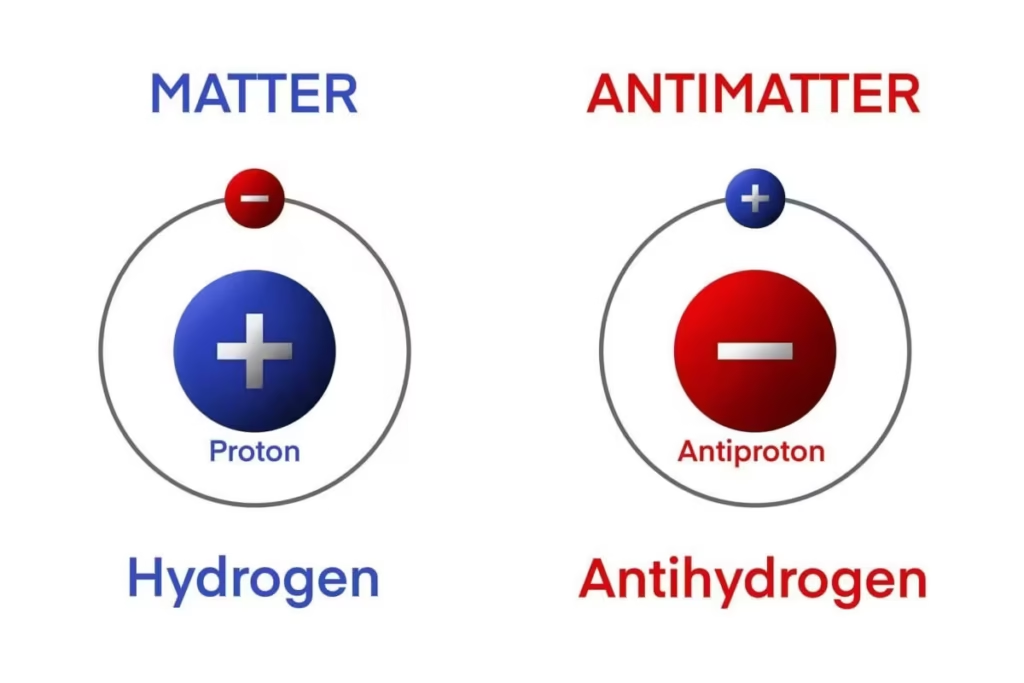
Positrons, also known as anti-electrons, are the antimatter counterparts of electrons. They share the same mass and spin as electrons but carry a positive charge. This article explores the fundamental characteristics of positrons, their discovery, the role they play in physics, and their practical applications. We will look into the processes through which positrons are produced and annihilated, their significance in particle physics, and their utilisation in medical imaging and material science. By examining these aspects, we aim to comprehensively understand positrons and their importance in theoretical and applied sciences.
Introduction to Positrons
Positrons, or anti-electrons, are elementary particles with a significant role in the area of particle physics and practical applications. These particles, being the antimatter counterparts of electrons, exhibit intriguing properties and behaviours that are fundamental to our understanding of the universe. This article provides an in-depth exploration of positrons, covering their characteristics, historical discovery, interactions, and various applications in science and technology.
Characteristics of Positrons
Fundamental Properties
Positrons possess several key properties that distinguish them from other particles:
- Charge: Positrons have a positive electric charge of +1 elementary charge, contrasting with the negative charge of electrons.
- Mass: The mass of a positron is identical to that of an electron, approximately 9.11 × 10⁻³¹ kilograms.
- Spin: Positrons, like electrons, have a spin of 1/2, classifying them as fermions.
- Antimatter Nature: As antiparticles, positrons exhibit behaviours that are opposite to those of electrons when interacting with other particles.
Production and Annihilation
Positrons can be produced through various processes, including:
- Beta Plus Decay: In certain radioactive isotopes, such as carbon-11 and fluorine-18, a proton can transform into a neutron, emitting a positron and a neutrino in the process.
- Pair Production: When high-energy photons interact with a strong electromagnetic field, they can produce a positron-electron pair.
The annihilation of positrons occurs when they encounter electrons. This interaction results in the complete conversion of their mass into energy, typically producing two gamma-ray photons:
e+ + e− → γ + γ
Discovery of the Positron
Theoretical Prediction
The British physicist Paul Dirac first predicted the existence of positrons in 1928. Dirac’s theory, known as the Dirac Equation, combined quantum mechanics and special relativity, suggesting the existence of particles with both positive and negative energy states. This led to the hypothesis of anti-electrons or positrons.
Experimental Confirmation
The positron was experimentally confirmed by Carl Anderson in 1932. Anderson observed tracks in a cloud chamber that indicated the presence of a positively charged particle with the same mass as an electron. This discovery earned him the Nobel Prize in Physics in 1936.
Role of Positrons in Physics
Quantum Electrodynamics (QED)
Positrons are integral to the field of quantum electrodynamics, which describes how light and matter interact. QED explains the processes involving electrons, positrons, and photons, providing a framework for understanding electromagnetic interactions at the quantum level.
Particle Physics
In particle physics, positrons are essential for studying fundamental forces and particles. Positron-electron collisions are utilised in particle accelerators to probe the properties of subatomic particles. The annihilation events produce high-energy photons, which help investigate the structure of matter.
Applications of Positrons
Medical Imaging: Positron Emission Tomography (PET)
One of the most significant applications of positrons is in medical imaging, specifically Positron Emission Tomography (PET). PET is a powerful diagnostic tool used to observe metabolic processes in the body.
- Tracer Injection: A biologically active molecule, labelled with a positron-emitting isotope (such as fluorine-18), is injected into the patient.
- Positron Emission and Annihilation: As the tracer decays, it emits positrons that quickly encounter electrons, resulting in annihilation and the production of gamma photons.
- Detection and Imaging: The PET scanner detects the emitted gamma photons, which reconstructs detailed images of the tracer distribution in the body.
PET scans are invaluable in oncology for detecting cancerous tissues, cardiology for assessing heart conditions, and neurology for studying brain functions.
Material Science
Positrons are also used in material science to investigate the properties of materials at the atomic level. Positron Annihilation Spectroscopy (PAS) is a technique that examines the electronic structure and defects in materials.
- Positron Injection: Positrons are introduced into a material, interacting with electrons and eventually annihilating.
- Annihilation Characteristics: The energy and angular distribution of the resulting gamma photons provide information about the electron density and defects within the material.
- Material Analysis: PAS is used to study metals, semiconductors, and polymers, offering insights into their structural properties and quality.
Positron Research and Future Directions
Advancements in Positron Emission Tomography
Research in PET technology continues to advance, with developments aimed at improving image resolution, reducing scan times, and enhancing the accuracy of diagnostic information. New radiotracers are being developed to target specific biological processes, expanding the range of conditions that can be diagnosed and monitored using PET.
Positron Applications in Quantum Computing
Emerging research explores the use of positrons in quantum computing. Positrons and positronium (a bound state of a positron and an electron) are being studied for their potential to perform quantum information processing tasks. The unique properties of positrons could offer advantages in developing more efficient and powerful quantum computers.
Antimatter Research
Positrons play a crucial role in antimatter research, which seeks to understand the fundamental symmetries of the universe. Experiments involving positrons and their interactions with other particles help to test theories of particle physics and cosmology. Understanding antimatter better could provide insights into the matter-antimatter asymmetry observed in the universe.
Conclusion
Positrons, the antimatter counterparts of electrons, are fascinating particles with significant implications in both theoretical and applied sciences. From their fundamental properties and historical discovery to their roles in quantum electrodynamics and particle physics, positrons offer a window into the subatomic world. Their applications in medical imaging, particularly in PET, have revolutionised diagnostic medicine, while their use in material science provides valuable insights into the properties of various materials.
Ongoing research continues to unveil new applications and deepen our understanding of positrons, highlighting their importance in advancing technology and expanding our knowledge of the universe. By exploring the multifaceted nature of positrons, this article aims to provide a comprehensive overview of their characteristics, significance, and future potential in science and technology.
Disclaimer
The content provided in this article, “Understanding Positrons: Characteristics, Discovery, and Applications”, is intended for informational and educational purposes only. It reflects the current understanding of the subject at the time of publication (03 July 2024) and should not be construed as professional scientific advice or a substitute for expert consultation.
Readers are encouraged to verify any data and consult relevant experts before drawing conclusions or applying the material in professional or research contexts.